May 2, 2023
CLTP12 will be held in Tokyo, on August 21 to September 1, 2023.
March 30, 2022
CLTP11 will be held in Tokyo, in August 18-31, 2022.
(Depending on the pandemic situation, the schedule might be changed.)
May 28, 2021
CLTP11 has been postponed to next year again due to the COVID19 pandemic.
April 23, 2020
CLTP11 has been postponed to next year.
February 28, 2020
CLTP11 will be held on August 17-28, 2020 at Nihon University, using HEPTA-Sat.
February 4, 2019
CLTP10 will be held on August 19-30, 2019 at Nihon University, using HEPTA-Sat.
January 19, 2018
CLTP9 will be held on August 20-31, 2018 at Nihon University, using HEPTA-Sat.
November 16, 2016
We are pleased to announce that CLTP8 hands-on training will be held at Nihon University with a new educational tool "HEPTA-Sat" in September 7-16, 2017.
November 16, 2016
CLTP7 movie is available.
January 24, 2016
About the Assessment Test
Suggested reading and more about the assessment test for CLTP7
January 16, 2016
CLTP6 Organizer Report 
CLTP6 report by one of the organizers.
November 30, 2015
CLTP7 Application
The detail of the application process for CLTP7 is released.
November 24, 2015
CLTP7
The second announcement of the 7th CanSat Leader Training Program is released!
October 1, 2015
CLTP7
The first announcement of the 7th CanSat Leader Training Program is released!
September 23, 2015
CLTP6 Movie is available!
September 8, 2015
CLTP6 Completed
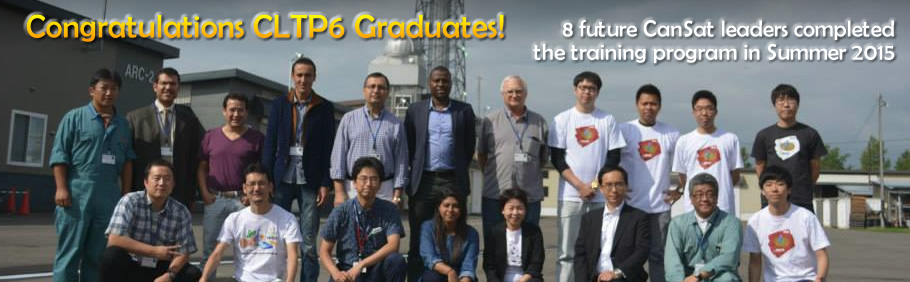
Congratulations CLTP6 graduates! 8 future CanSat leaders completed the training program. More details will follow.
June 28, 2015
Activity Report Worldwide
CanSAT training program will be held on August 21-29, 2015 at Terzioğlu campus, Çanakkale Onsekiz Mart Universitesi in Çanakkale, Turkey.
Mansur Çelebi, Class of CLTP1
June 14, 2015
The CLTP6 online-lecture will start on July 13, 2015.
If you wish to join the CLTP6 online-lecture, please register.
You will receive notification soon.
(Deadline: July 3, 2015)
March 10, 2015
United Nations Office for Outer Space Affairs (UNOOSA) is supporting CLTP6 partifipants with USD 5000 for airfare (only for
participants from developing countries in the UN definition.)
February 19, 2015
Due to several requests, the application deadline for CLTP-6 has been extended from February 28 to March 18, 2015.
However, we will take it into consideration if you will submit your application before the original deadline.
February 7, 2015
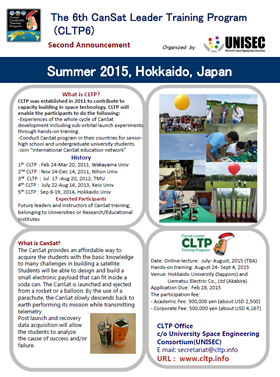
- Download the CLTP6 brochure!
- More about CLTP6
February 1, 2015
Activity Report Worldwide
CanSat/water Rocket Leadership Training Program (CRLTP) was organized by UNISEC-NIGERIA in 2014
January 24, 2015
Overview of the 6th CanSat Leader Training Program is released!
[More]
January 24, 2015
Voice of participants of the previous CLPT programs
January 9, 2015
See the CanSat training program in Egypt
December 7, 2014
The Background Assessment Test for the CLTP6 is available
 in word formant or in pdf format.
Visit the Application page for more detail.
December 3, 2014
First annoucement of the 6th CanSat Leader Training Program (CLTP6)
Scheduled in Summer 2015. The details will follow in the next annoucement. Stay tuned!
December 3, 2014
First annoucement of the 6th CanSat Leader Training Program
Scheduled in Summer 2015. The details will follow in the next annoucement. Stay tuned!
October 7, 2014
Congratulations CLTP5 graduates!
The seven participants completed the training program. The program was funded by Sakura Rubber Company, Ltd.
September 9, 2014
Meet the CLTP5 participants!
September 9, 2014
CanSat Mapping maps the CanSat activities on Earth
Google Earth required
July 26, 2014
If you wish to join the pre-CLTP5 online-lecture,
please sign up at:
http://goo.gl/zWn3r9
You will receive notification soon.
(Deadline: July 30)
July 25, 2014
We will urgently recruit a few more participants for CLTP5.
The pre-CLTP5 Online Lecture will start on August 1st, and hands-on training will
be held in Sep 8-19 in Hokkaido, Japan.
Application format and assessment test for CLTP5 can be downloaded at: http://cltp.info/application.html
(Deadline is July 30)
February 22, 2014
CLTP5 application deadline has been extended to Friday 7 March, 2014
(Japan Standard Time 5:00PM).
[How to Apply]
February 6, 2014
Introduction to the 5th CanSat Leader Training Program
Apply to the 5th CanSat Leader Training Program online!
[How to Apply]
November 19, 2013
- The 2nd annoucement of the 5th CanSat Leader Training Program is released.
- The background assessment test is now available.
- FAQ was updated!
October 10, 2013
The first annoucement of the 5th CanSat Leader Training Program is released.
September 30, 2013
Congratulations CLTP4 graduates!
July 22 – August 16, 2013
The 4th CanSat Leader Training Program
May 27, 2013
Mr. Quarshie, Class of CLTP2, organized a CanSat activity in Ghana in May 2013. [more].
March 6, 2013
Mr. Nnadih, Class of CLTP2, organized a CanSat activity in Nigeria in May 2012. [more].
December 29, 2012
Prof. Nakasuka's lecture during CLTP3
October 22, 2012
First Announcement for CLTP4 was released
October 22, 2012
See the biographies of the CLTP3 graduates!
May 11, 2012
Visit our CLTP3 blog!
March 18, 2012
FAQ was updated.
March 15, 2012
CLPT3 application is closed.
Thank you for your applications!
March 10, 2012
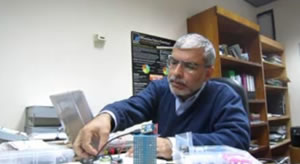
Message from CLTP1 participant-
Dr. Mohammed Khalil Ibrahim, Cairo University, Egypt.
March 10, 2012
CLTP OFFICE channel is open on Youtube.
March 4, 2012
See See the biographies of the CLTP2 graduates.
March 3, 2012
See the CanSat activities by the CLTP graduates.
February 20, 2012
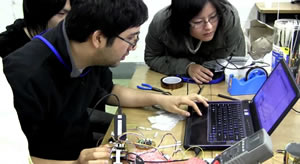
Video clip from CLPT2 (5m30s).
January 26, 2012
Check out our Facebook and Twitter!
November 11, 2011
The second Cansat Leader Training Program (CLTP2) will begin on Monday, November 14, 2011.
November 10, 2011
CLTP 2 blog